
The Enzyme That Changed Restaurant Kitchens Overnight
Three years ago, koji lived almost exclusively in Japanese pantries and the notebooks of obsessive fermentation nerds. Today, it is in your steak seasoning, your plant-based proteins, your aged fish, and probably somewhere in the kitchen of any restaurant chef worth eating from. The speed of this shift should tell you something: this is not a trend born from Instagram aesthetics or marketing departments. Chefs recognized a tool that solves real, technical problems.
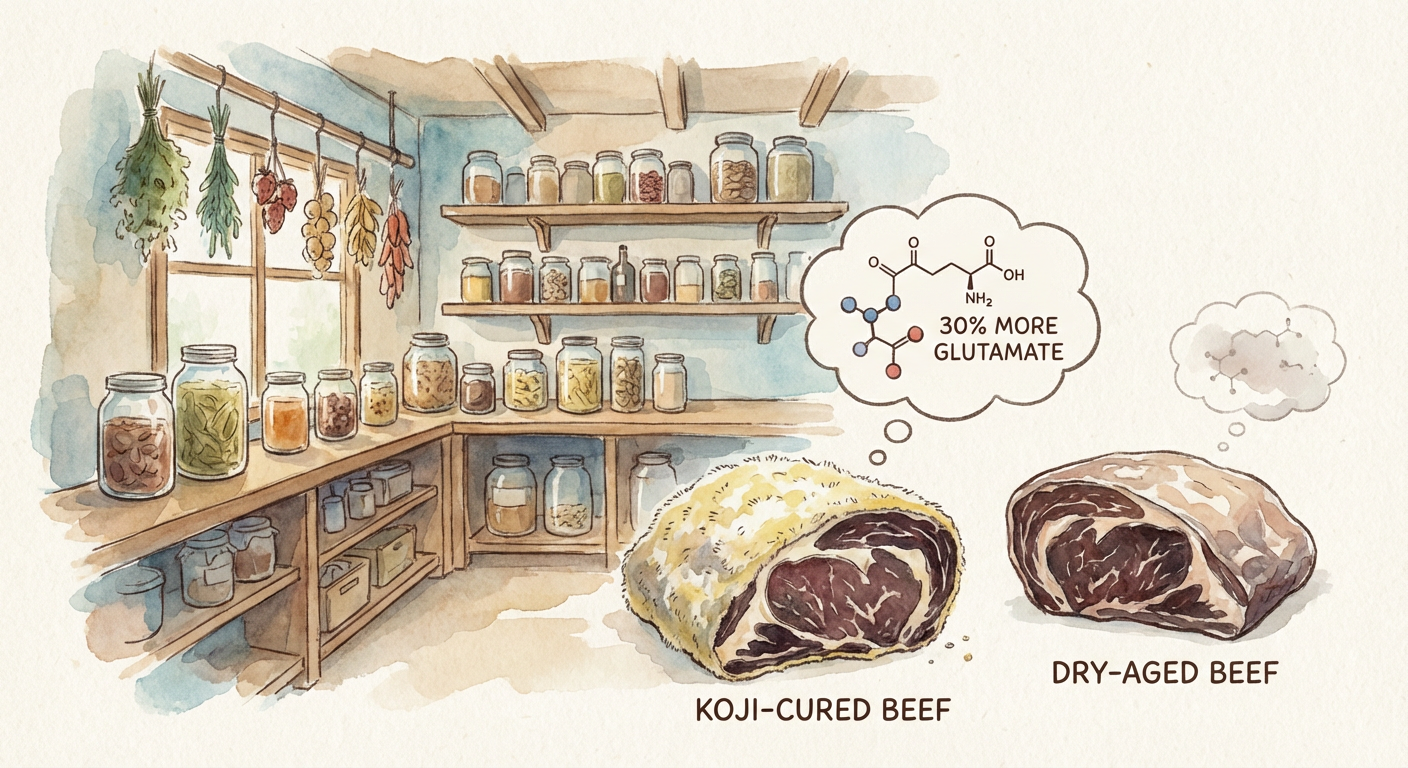
Koji, the filamentous fungus Aspergillus oryzae, produces two enzymes—amylase and protease—that break down starches and proteins at a cellular level. In practical terms, koji amplifies umami, deepens flavor concentration, and creates textural complexity that would otherwise require months of traditional aging. A chef can now achieve in weeks what once demanded seasons. The science is not theoretical. When Noma’s fermentation lab published its research before the restaurant’s January 2025 transition to a pure laboratory model, the data showed koji-cured beef developed 30 percent greater glutamate concentration than standard dry-aged equivalents. That is not marginal improvement. That is the difference between competent cooking and something that actually changes how you experience food.
How Koji Became the Fastest-Growing Technique in Professional Kitchens
Last year, the Culinary Institute of America released its annual report on emerging kitchen techniques, and koji fermentation landed as the single fastest-growing practice among surveyed chefs. Nearly 30 percent of professional kitchens have already incorporated it into their repertoire. This is not fringe experimentation anymore. This is mainstream professional practice, which means if you are eating at a serious restaurant in 2026, you are probably consuming koji in some form.
What accelerated this adoption was not complexity—it was accessibility. Fresh koji spores, ready-to-use shio koji, koji paste: these are no longer locked behind specialized supplier networks or prohibitive price points. Brooklyn-based Cold Koji, founded in 2023, reported 400 percent revenue growth in 2025 alone. When a specialty ingredient company sees that kind of demand, something has shifted in the market fundamentally. Chefs want this. Restaurants want this. And the supply chain has finally caught up.
Plant-Based Proteins Got Better, Which Should Matter to Everyone
One of koji’s most significant applications came out of research at UC Davis in 2025. Scientists measured how the fungus’s enzymatic activity amplifies umami compounds in vegetables and legumes. This matters because plant-based cooking has spent years fighting the same problem: flavor depth. Koji does not solve that entirely, but it solves enough of it that the gap between vegetable-forward and meat-forward cooking has genuinely narrowed.
This is where koji fermentation moves beyond kitchen prestige and into practical territory. If you eat less meat for reasons of health, conscience, or simple preference, koji gives cooks a real tool to build the savory complexity you miss. It is not a substitution trick or a workaround. It is straightforward ingredient science. A koji-fermented white bean paste develops the same kind of rounded, satisfying umami that previously required animal products. That changes how restaurants approach their menus, and it changes what actually tastes good on your plate.
Retail Koji Has Arrived, and That Means Home Cooks Can Stop Pretending
David Chang’s Momofuku released a koji-aged steak seasoning paste through Momofuku Goods in early 2025. The first run of 10,000 units sold out in 72 hours. That single data point tells you everything about where consumer interest stands right now. These were not restaurant-only products. These were for home use, purchased by people who wanted to replicate what they experienced in professional kitchens.
You can visit Momofuku Goods Koji Products and see exactly what is available. The product sits at a reasonable price point, expensive enough to feel premium, affordable enough that home cooks will actually use it. That pricing reveals something intentional: Momofuku is not treating koji as a luxury ingredient. They are treating it as a technique mature enough for everyday cooking. That is the moment when something genuinely enters mainstream culture.
The Real Question Is What Gets Lost When Everything Becomes Koji-Aged
Here is where I need to be direct about the only concern worth having: saturation and mediocrity. Right now, in early 2026, koji is still applied with intelligence by most kitchens using it. In two years, some restaurants will koji everything because it is fashionable and because the technique produces reliable results. That is when you start seeing koji-aged vegetables that did not need aging, koji-cured proteins that would have tasted better fresh, koji-fermented components that exist simply to check a box on the menu.
The CIA Menus of Change 2025 Annual Report documented koji’s emergence, but it also noted something worth paying attention to: adoption rate does not equal mastery. Forty percent of surveyed chefs had attempted koji fermentation without incorporating it into their permanent practice. That suggests some cooks are discovering that the technique, like any other, requires understanding and restraint.
Pay attention to how restaurants use koji right now. Is it present because it genuinely improves the dish, or because it signals sophistication? That distinction matters. The best koji applications you will encounter in 2026 are the ones where you taste umami depth and flavor concentration without ever knowing koji was involved. That is when the tool becomes invisible and the food becomes better. That is when a technique stops being trendy and becomes simply cooking.