
The Fermentation Gap That Changes Everything
I spent three years working in a kitchen where we made our own miso from scratch. We’d source beans, inoculate koji, and wait. And wait. Twelve weeks minimum before we had something worth using. But here’s what I learned that actually matters: most commercial miso you buy at the supermarket hasn’t fermented for twelve weeks. It’s been fermented for three. Sometimes less. The manufacturers spray koji spores, add salt, let time do the bare minimum, and call it done. It’s expedient. It’s profitable. It’s also why so many people think miso is just a one-dimensional salty paste.
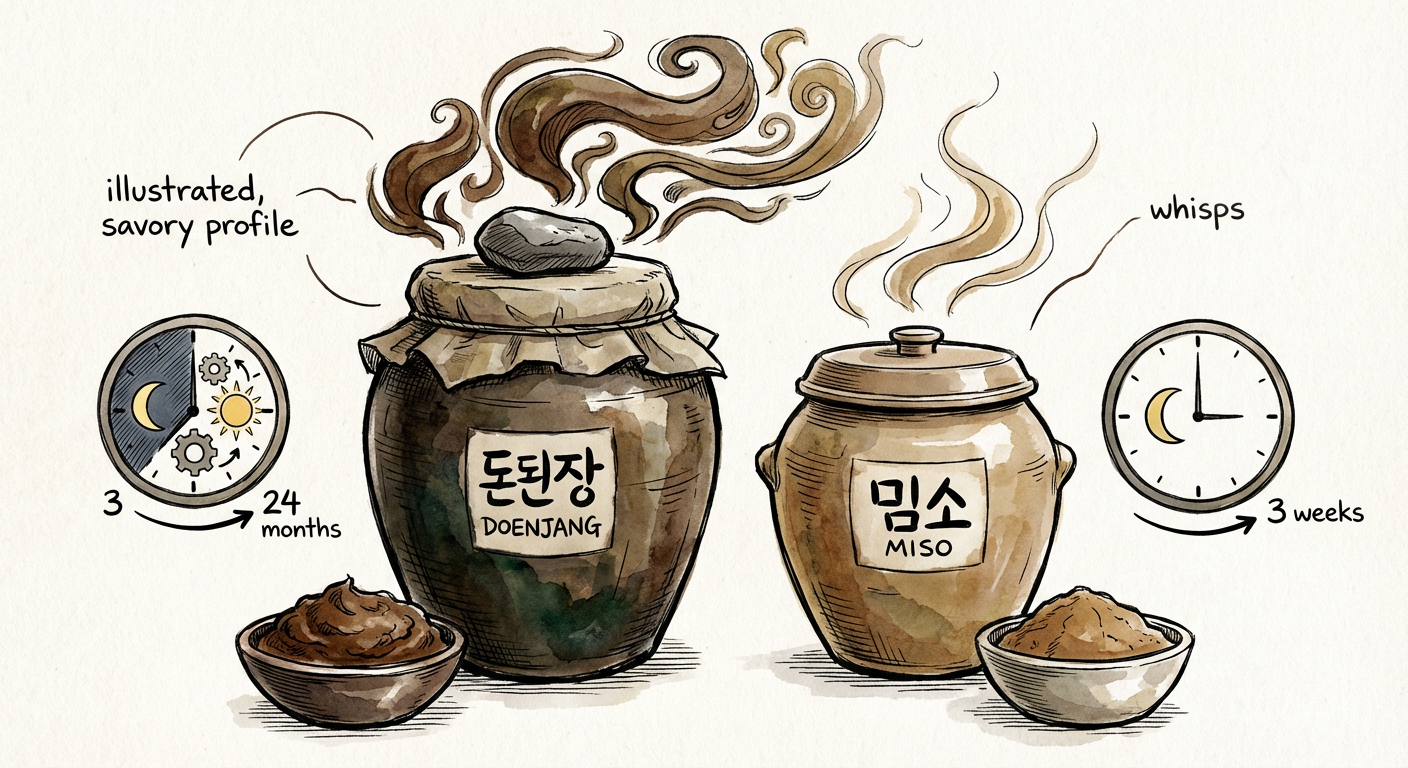
Doenjang operates under a completely different timeline. Traditional fermentation runs anywhere from three months to two years. Some premium varieties sit in earthenware vessels for significantly longer. That extended fermentation period isn’t romantic nostalgia. It’s chemistry. The longer those soybeans and koji sit together, the more complex enzymatic breakdown occurs. Proteins transform into amino acids. Sugars develop into compounds that your palate actually registers as depth rather than salt.
The numbers tell the story. A 2025 study analyzing volatile flavor compounds found that traditionally fermented doenjang contains over two hundred distinct aromatic molecules. Industrial miso? Fewer than ninety. You’re literally tasting half the complexity. That’s not a subtle difference. That’s the difference between a flat note and a full chord.
Economics and the Global Fermented Foods Boom
Money moves markets. The global fermented foods sector was valued around eight hundred thirty-nine billion dollars in 2024 and is on track to exceed one point one trillion by 2030, according to the Grand View Research fermented foods market report. That kind of growth attracts investment, innovation, and competition. It also attracts capital to regions producing these foods at scale.
South Korea understood this moment. Sempio, the nation’s largest condiment manufacturer, increased North American doenjang exports by thirty-four percent between 2023 and 2025. That’s not a minor uptick. That’s aggressive market penetration backed by supply chain confidence and quality consistency. They’re not flooding grocery stores with a mediocre product and hoping volume compensates for lack of flavor. They’re shipping fermented paste that actually tastes like something.
What’s happening in the broader market reflects something real. The fermented foods category is seeing a genuine shift toward longer fermentation periods and traditional methods. Consumers with access to information are learning that quick fermentation is a compromise, not a feature. Producers who’ve built their reputation on speed are suddenly vulnerable. The economics now reward patience.
When a Celebrity Chef Validates What You Already Knew
Late in 2025, David Chang released a content series through Majordomo Media that did something food media hadn’t quite done yet. He walked through gochujang and doenjang applications side by side, contrasting their roles in Korean cooking with precision and without the usual mystification. He wasn’t being precious about tradition. He was being practical about function. Here’s what each condiment does. Here’s where it excels. Here’s why you’d choose one over the other.
That kind of clarity matters because it gives permission. Home cooks had been intimidated by doenjang because mainstream food writing treated it as either exotic or interchangeable with miso. Chang’s work made clear that doenjang occupies its own category. It’s not a substitute. It’s not a variant. It’s a separate tool with specific applications where it’s superior. The mainstream food conversation shifted because someone with credibility said what had been quietly obvious to anyone who’d actually tasted both.
What I found significant wasn’t the content itself but the timing. By late 2025, the ingredients and supply were already in place. The Journal of Ethnic Foods doenjang flavor compound study had already documented the technical superiority. Distribution channels had already expanded. The celebrity validation simply accelerated something that was already in motion.
The Practical Reality for Your Kitchen and Budget
You don’t need to spend a fortune to experience the difference. I’ve tested entry-level doenjang against premium miso in the same recipes. A decent Korean doenjang runs about the same price as quality imported miso. Sometimes less. The flavor return is objectively higher. You’re getting more glutamate compounds, more umami backbone, more reason to use less in a dish because the flavoring is more concentrated.
Here’s where the value argument gets interesting. A jar of proper doenjang lasts longer in actual cooking because you’re not compensating for lack of depth with volume. A tablespoon of well-fermented doenjang in broth reads as rich and complete. A tablespoon of industrially-fermented miso leaves you adding more salt, more soy, more of something to get to that same place. The cost per use skews heavily toward doenjang.
I’ve also noticed that doenjang’s broader umami profile makes it more versatile than people expect. It’s obviously excellent in soups and stews. Less obvious but equally effective in vinaigrettes, in barbecue marinades, mixed into mayo for sandwiches, or whisked into pan sauces for meat. It’s more aggressive than miso in some contexts, but that aggressiveness is flavor, not harshness. It commands attention rather than demanding it.
Where Miso Isn’t Going Anywhere, But It’s Also Not Gaining Ground
I want to be clear about what I’m arguing. Miso is excellent. White miso, red miso, the whole spectrum has legitimate applications. If you’ve built your cooking practice around miso, that’s not a mistake you need to correct. But the conversation about fermented soybean paste has been dominated by Japanese ingredients long enough that people assume it’s the only serious option. It’s not. And the global market is finally noticing.
What’s happening with doenjang isn’t about miso being bad. It’s about an alternative being dramatically undervalued for years. The fermentation science supports it. The flavor analysis supports it. The supply chain now supports it. The mainstream media is catching up. By 2026, I’d predict you’ll see doenjang on more restaurant menus and in more home kitchens, not because it’s trendy, but because once people taste the actual difference, the choice becomes obvious.
Have you tried a properly fermented doenjang yet? More importantly, have you compared it directly to whatever miso you’ve been using? I’d be interested to hear what you notice. The shift isn’t theoretical. It’s taste.